iPhone app for endurance sport · TestFlight beta

Not a training plan. Yours.

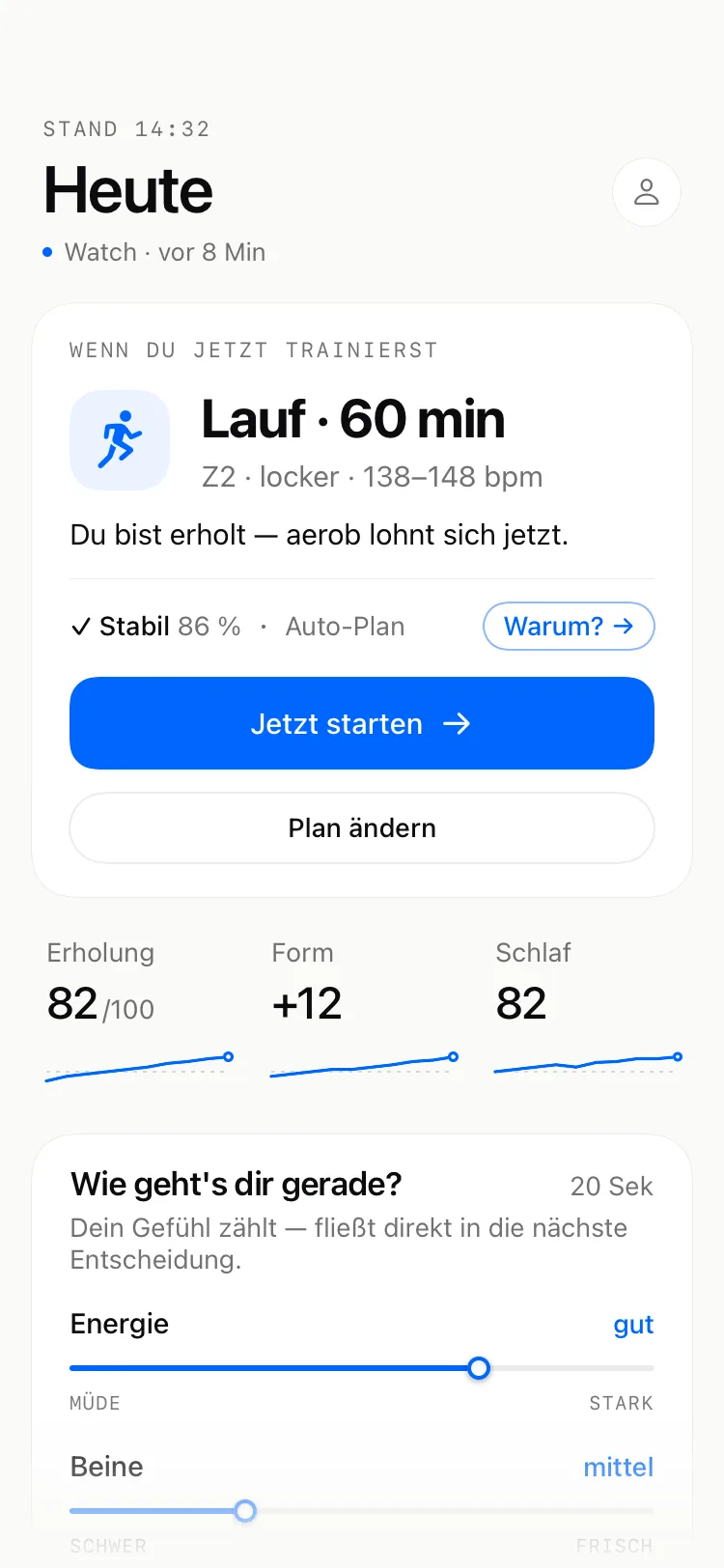
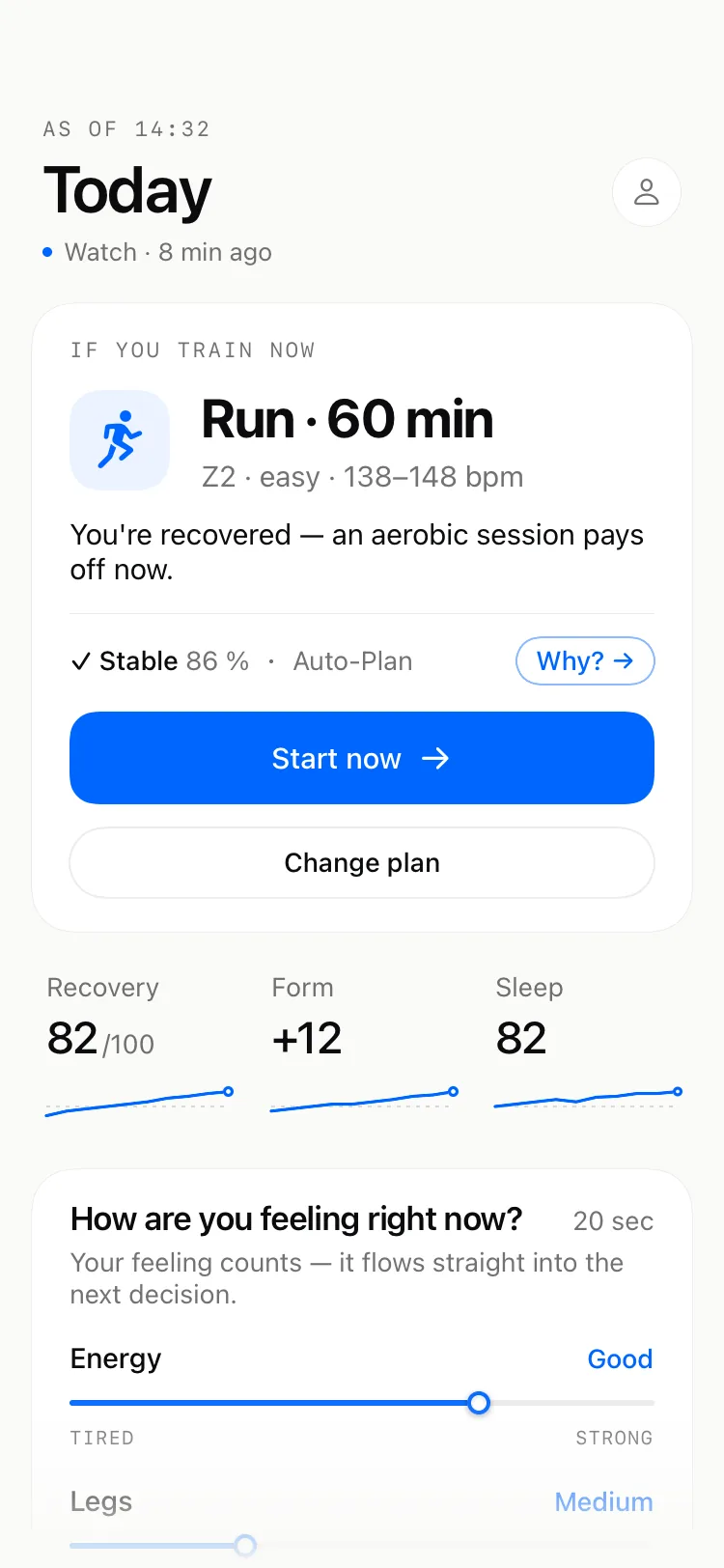
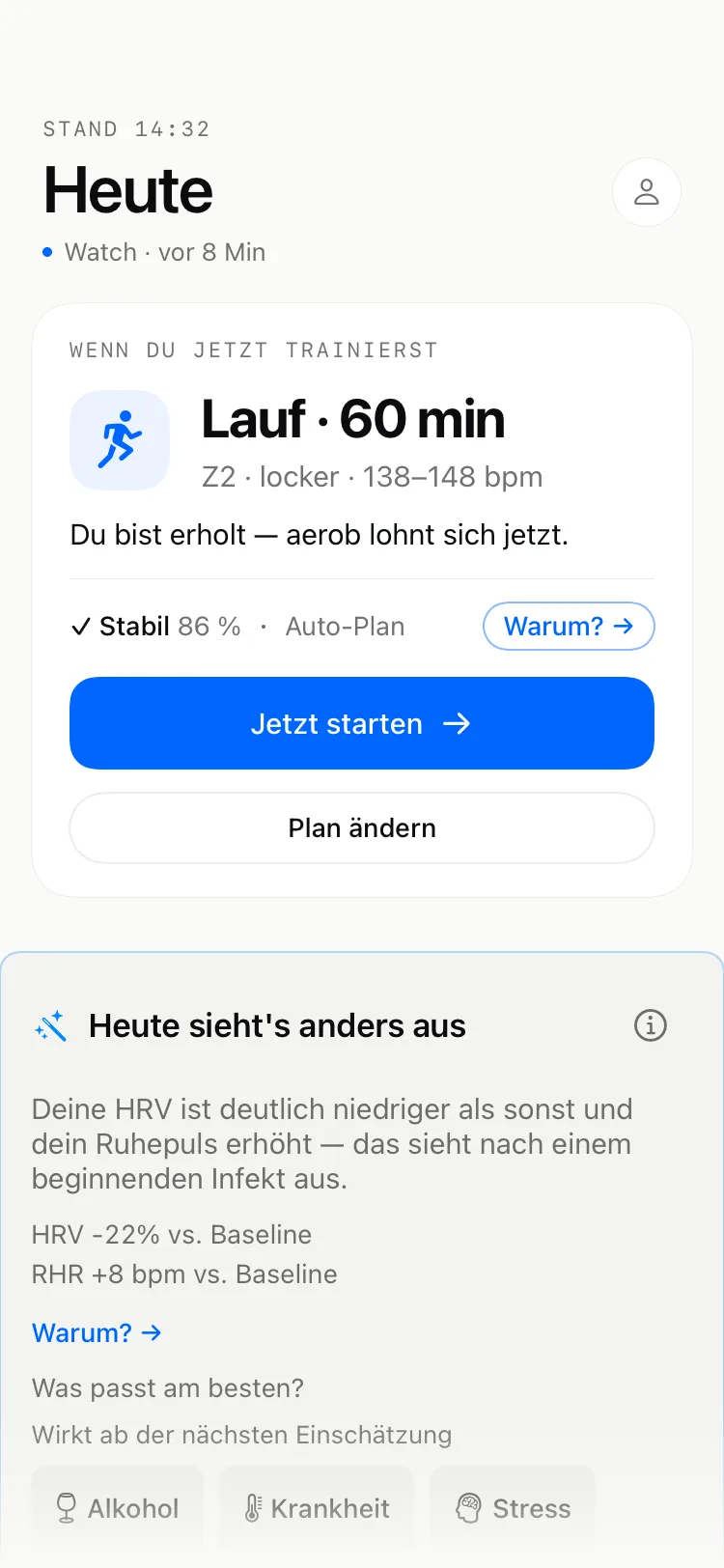
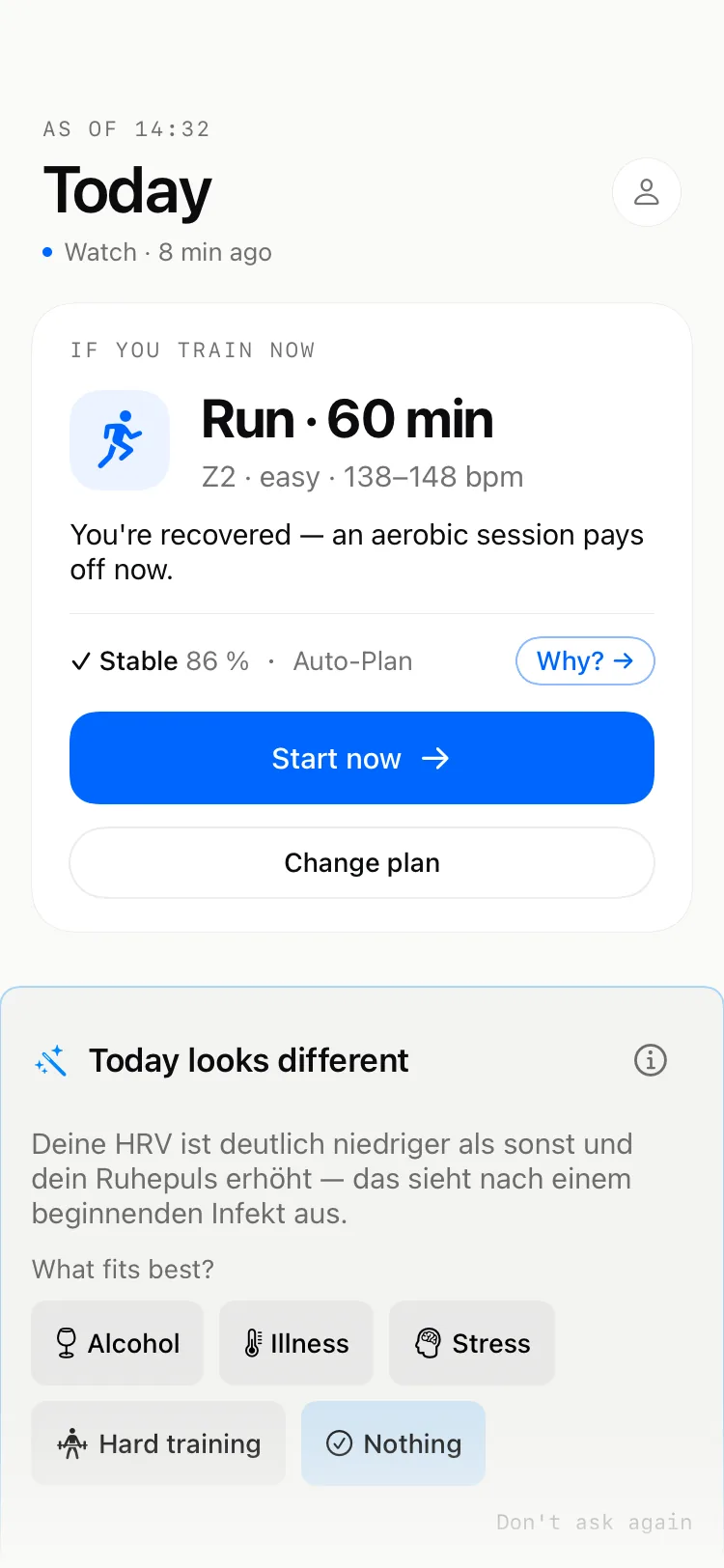
You open the app before you head out — and it tells you, for this moment, what to do: sport, duration, intensity, zones. Grounded in sports science, computed on your iPhone.

No account No cloud Provider-independent

The decision·Today

One recommendation, not ten options

← swipe or drag · also advances on its own →

6signals per decision
7disciplines incl. rest
0accounts · servers · trackers
100 %computed on device

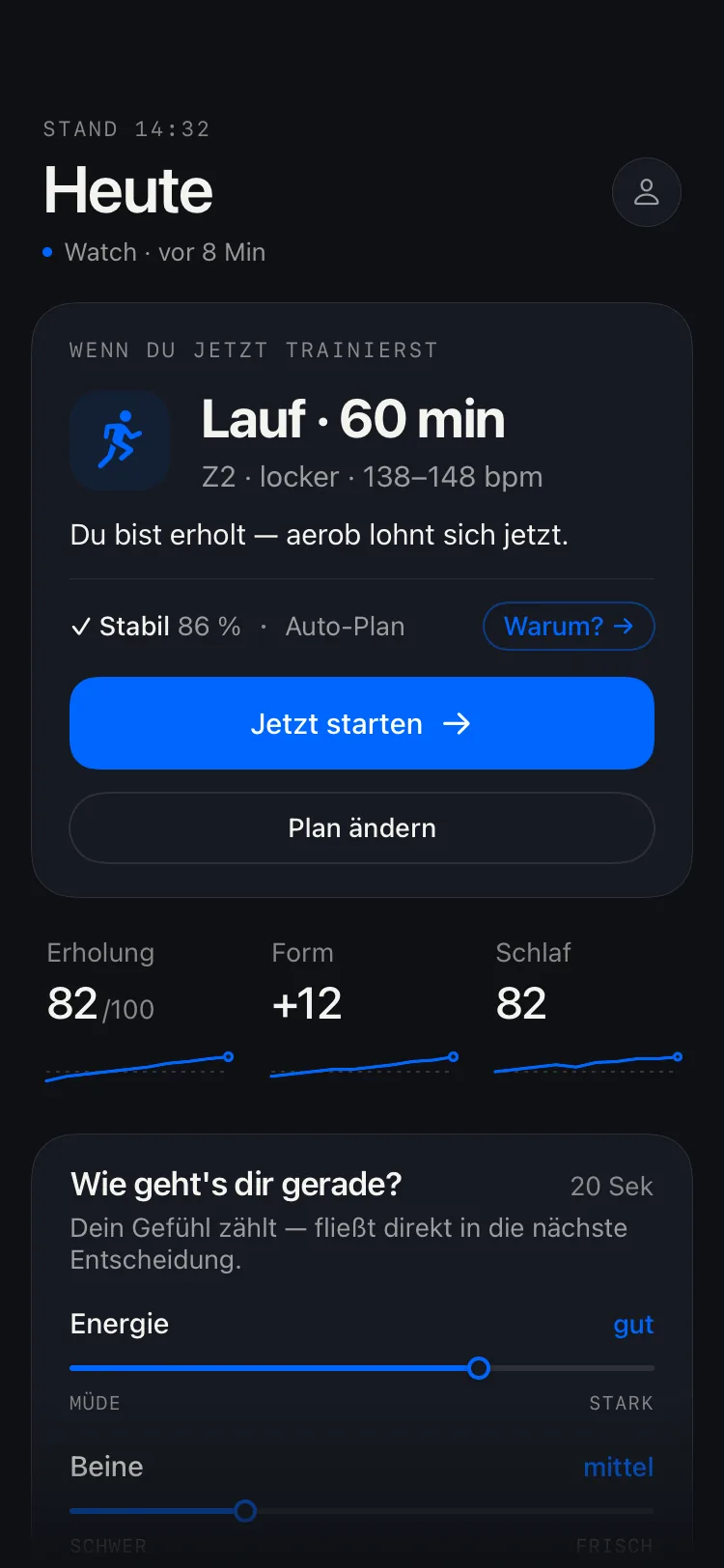
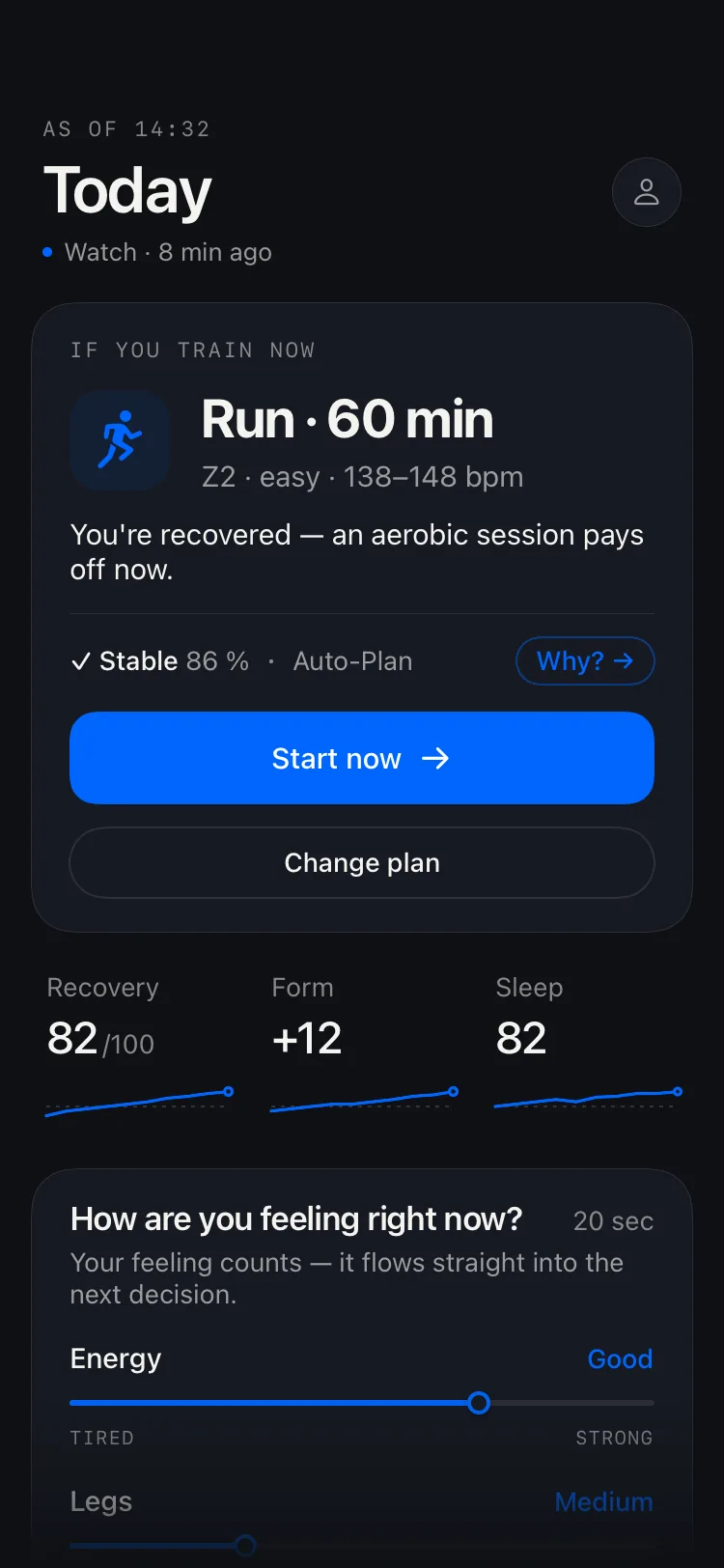
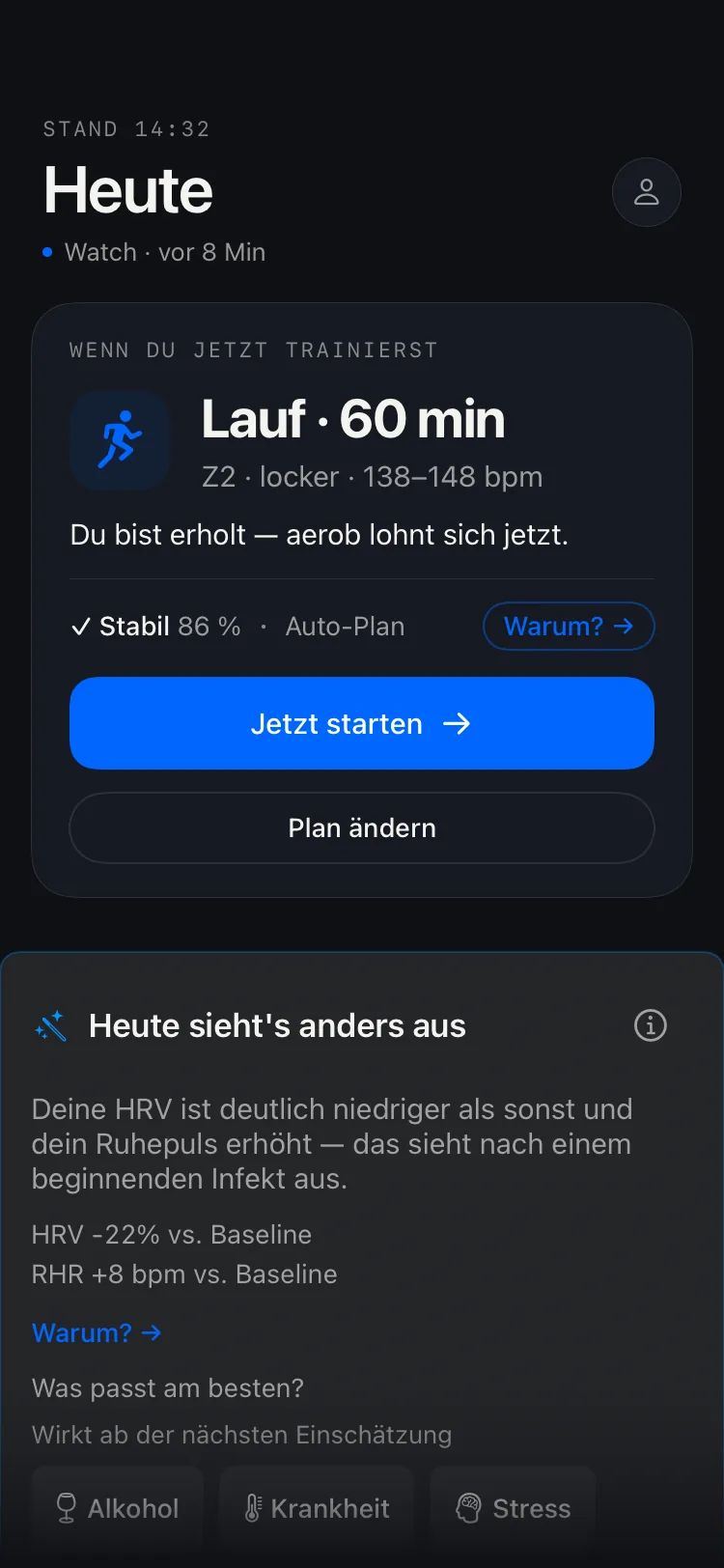
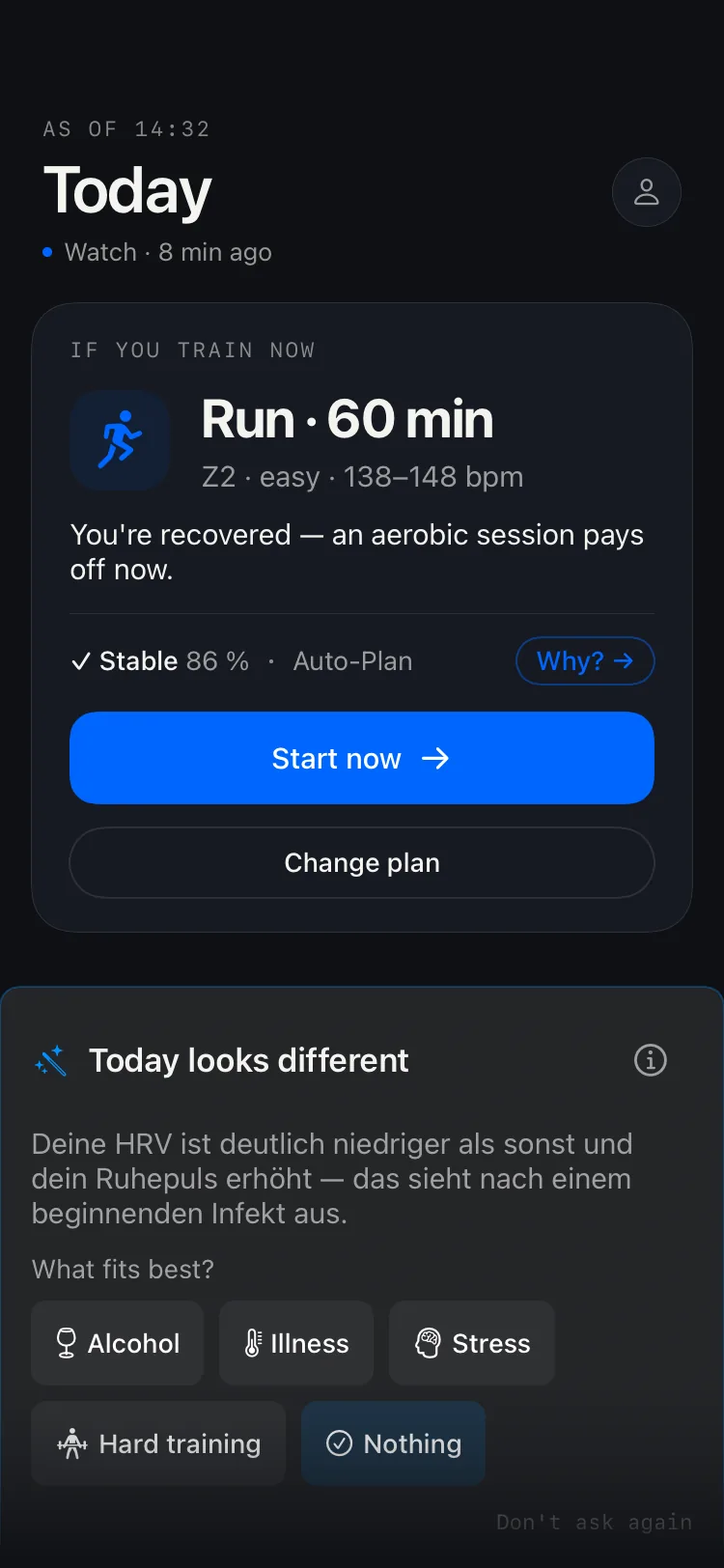
Short film: at your actual time of day you want to head out. Depending on the hour, your night, your morning or your whole day is already in — sleep, HRV, check-in, steps, resting heart rate, load. That becomes one decision for exactly this moment, tailored to your goal and your profile, computed locally on your iPhone. Afterwards the app asks how it went — and decides better next time.

Not a video — real app screens, and the clock is yours.

The difference

Not an app that guesses.

A coach doesn't guess — he measures, classifies and explains. That's what's built in here: derived from sports science, learned from your own data, computed entirely on your device.

200+data fields feed every decision

Now — not this morning.Other apps hand you a day plan over breakfast. DecisionEngine computes the moment you open it: 06:40 gives a different answer than 19:20 — because your life happens in between. A short night, a stressful meeting, two hours that opened up: the recommendation adapts instead of holding it against you.
It also says no.A coach that says “go” every day isn't a coach. At 5.8 h sleep and HRV −18 % you get a recharge day — with the reasoning, and an easy alternative. Same for a starting infection or a declared injury: sport and intensity stay capped until it holds again.
No off-the-shelf plan.The app derives your athlete type per sport — sprinter, climber, endurance, all-rounder — from your thresholds and your performance curves. Not asked for, recognised. Your training follows that type, not an average.
When the data is thin, it says so.Instead of inventing a number, the engine says “not enough data for that yet”. That's deliberate — a made-up readiness is worse than none. The longer you're on board, the sharper the picture gets.

Disciplines

Six sports. And rest as the seventh answer.

RunZones · pace · ACWR
BikeWatts · zones · load
SwimDistance · technique
StrengthMuscle groups · sets
BrickBike → run in one go
Cross-countryreplaces running in winter
Restalso a decision

Strength counts as its own discipline in total load — leg day doesn't collide with the long run. For triathlon: readiness per discipline, brick as its own session.

Auditable

“Why?” is an answer, not a promise.

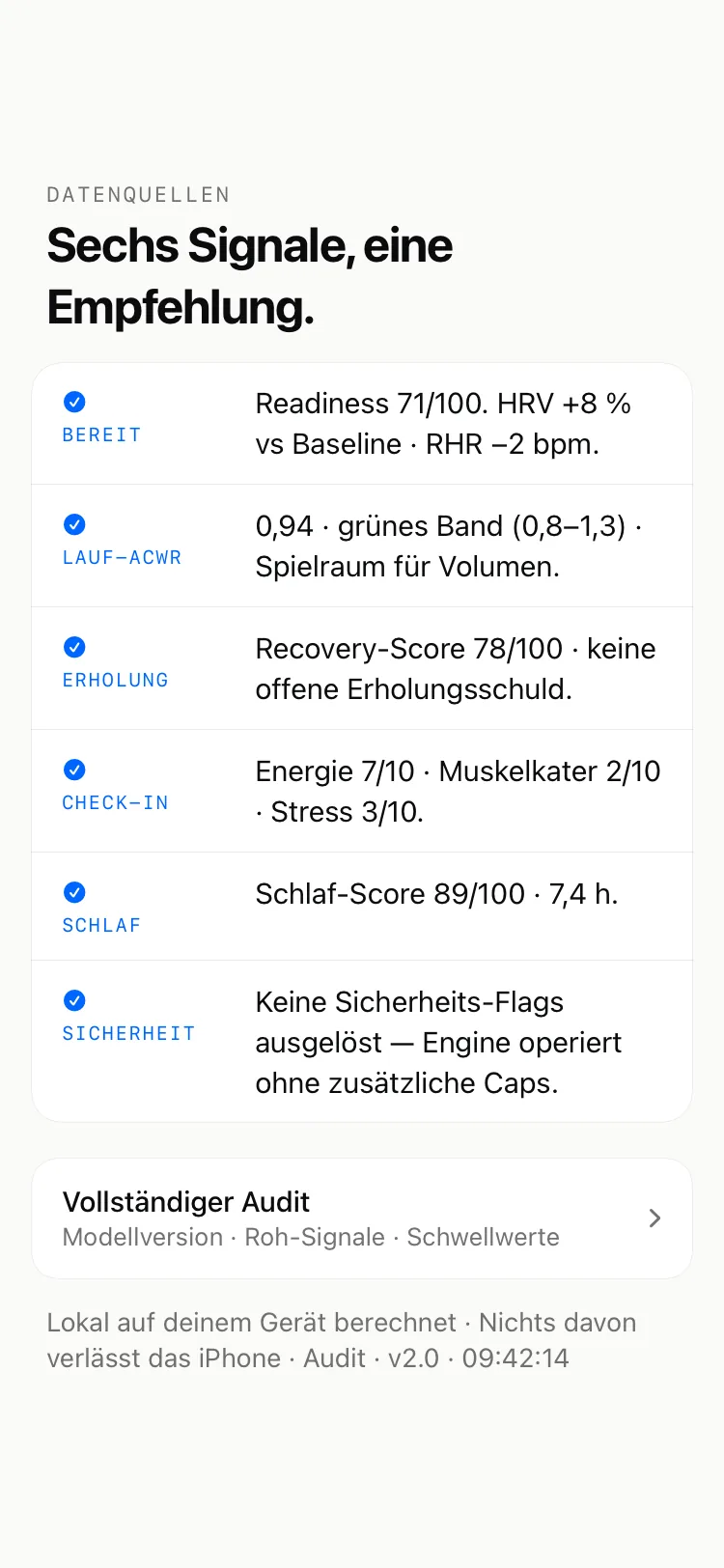
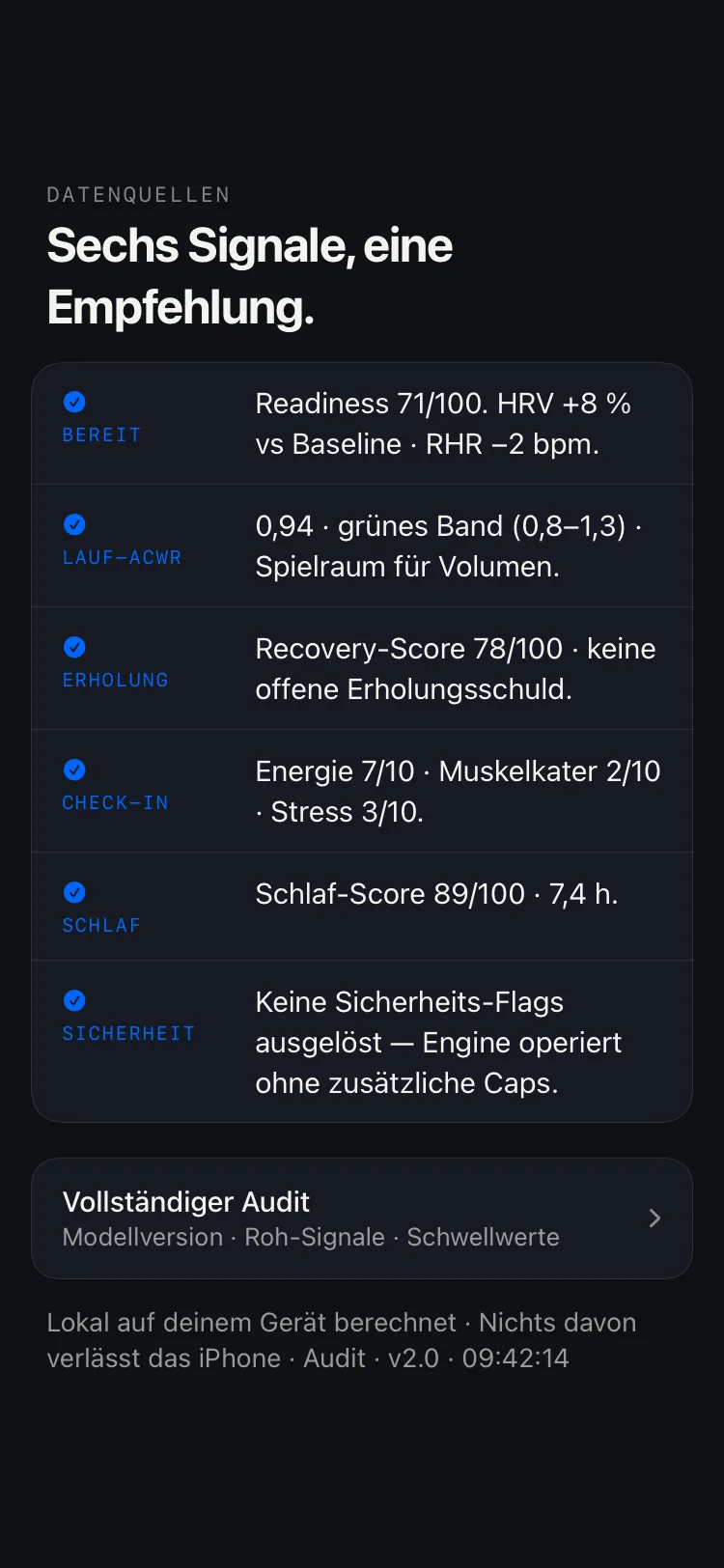
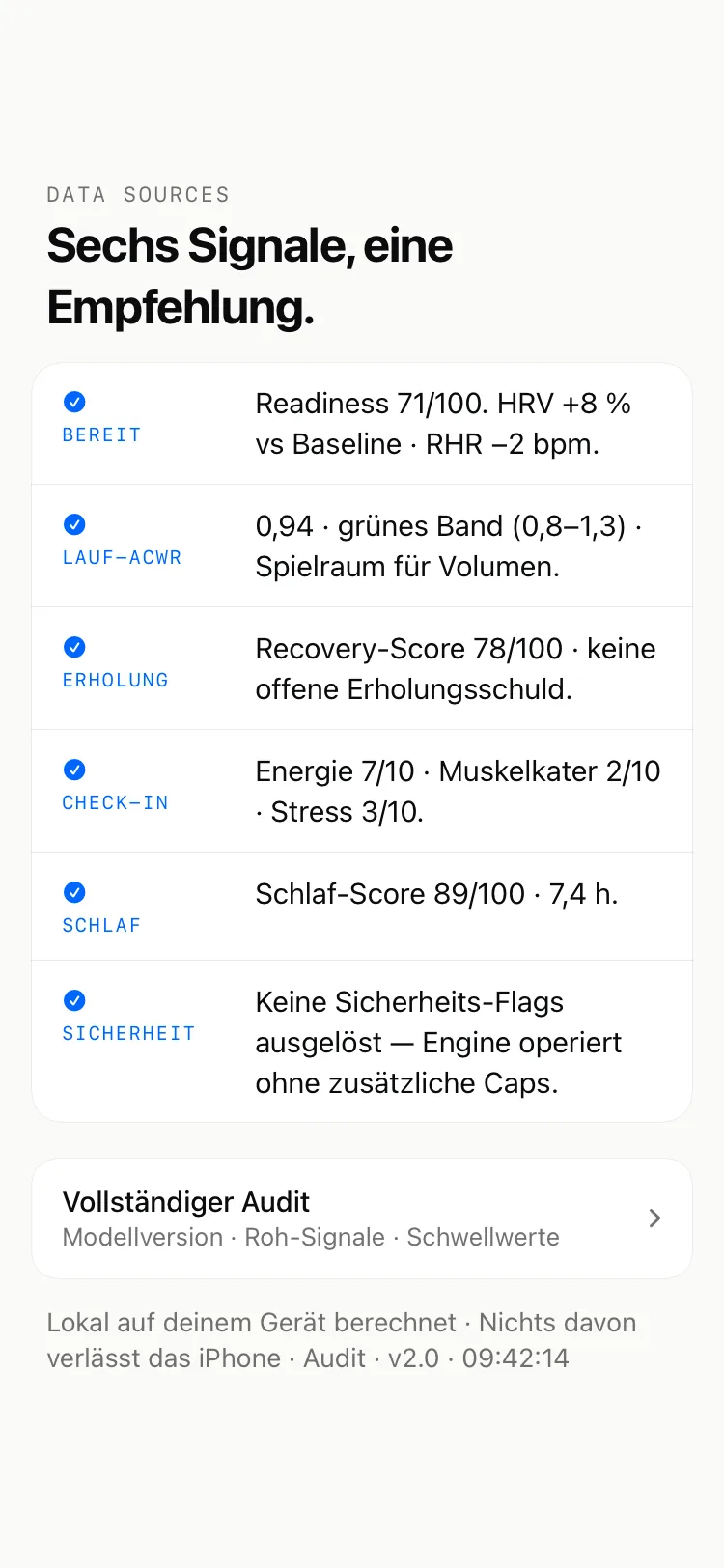
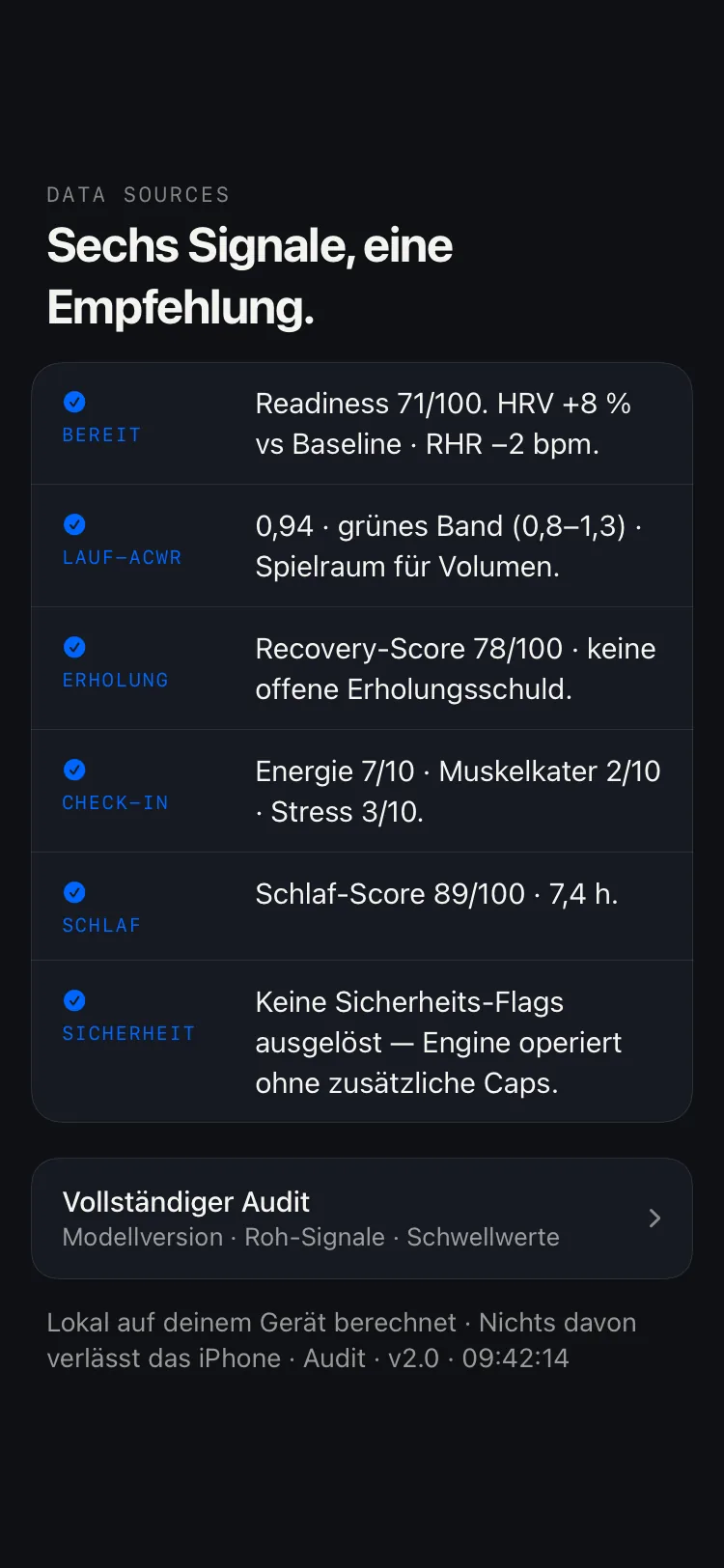
One tap on “Why?” and you see every signal that carried the decision — including the safety pass that found nothing. Computed on device.

Tier 1The decision — sport, duration, intensity, zones.
Tier 2The six signals, each with its value and band.
Tier 3Raw signals, thresholds, model version, timestamp.
DecisionEngine Decision Trail: the signals behind a recommendation, broken down in three tiers DecisionEngine Decision Trail: the signals behind a recommendation, broken down in three tiers DecisionEngine Decision Trail: the signals behind a recommendation, broken down in three tiers DecisionEngine Decision Trail: the signals behind a recommendation, broken down in three tiers

From measurement to decision

Data is the input, not the output.

Any app can collect numbers. The work is reading how they relate — HRV against sleep against load against your goal — and drawing a conclusion that changes your next session. Instead of blindly grinding on. Six places where exactly that happens.

DecisionEngine race-readiness screen: training phase, readiness percentage and radar against a race goal DecisionEngine race-readiness screen: training phase, readiness percentage and radar against a race goal DecisionEngine race-readiness screen: training phase, readiness percentage and radar against a race goal DecisionEngine race-readiness screen: training phase, readiness percentage and radar against a race goal

Race readiness

Against a goal, not into the blue.

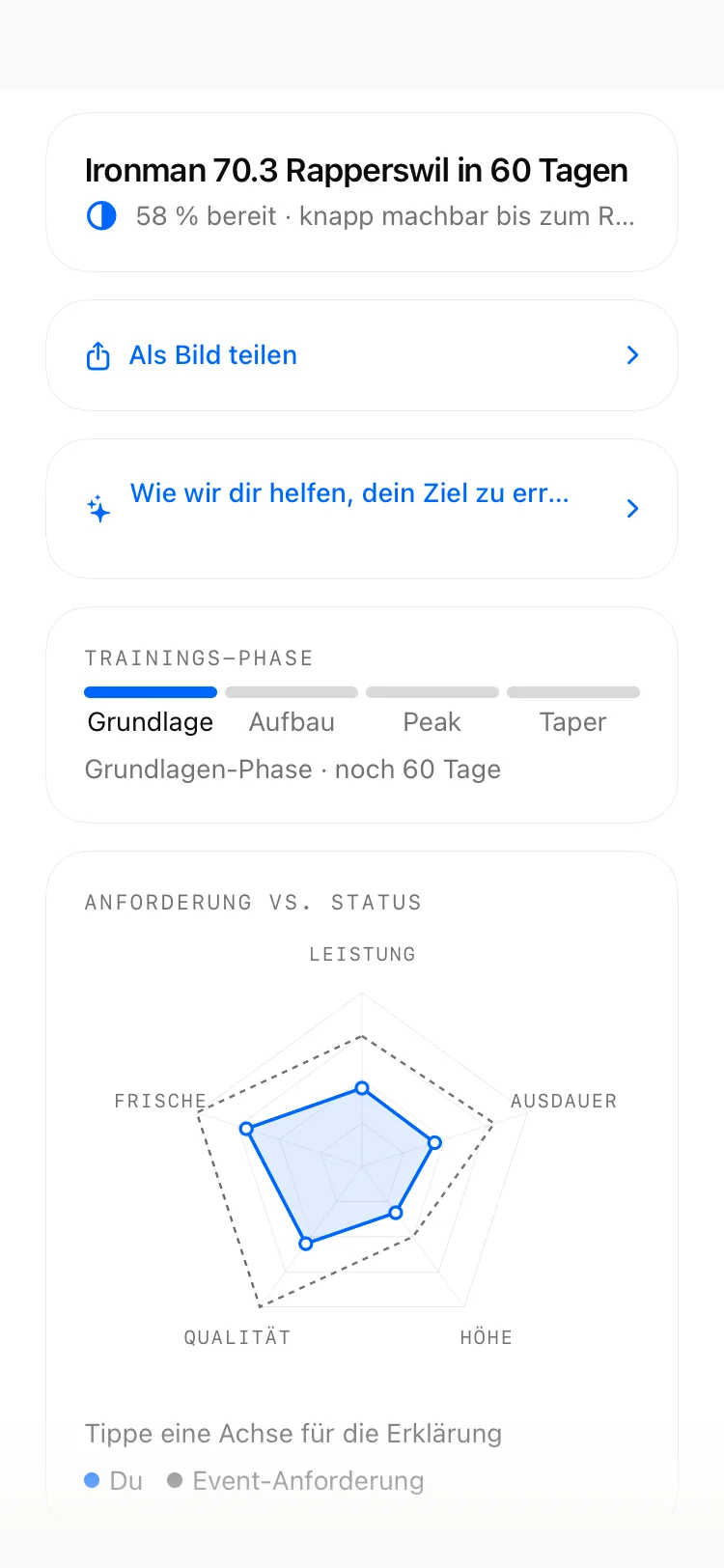
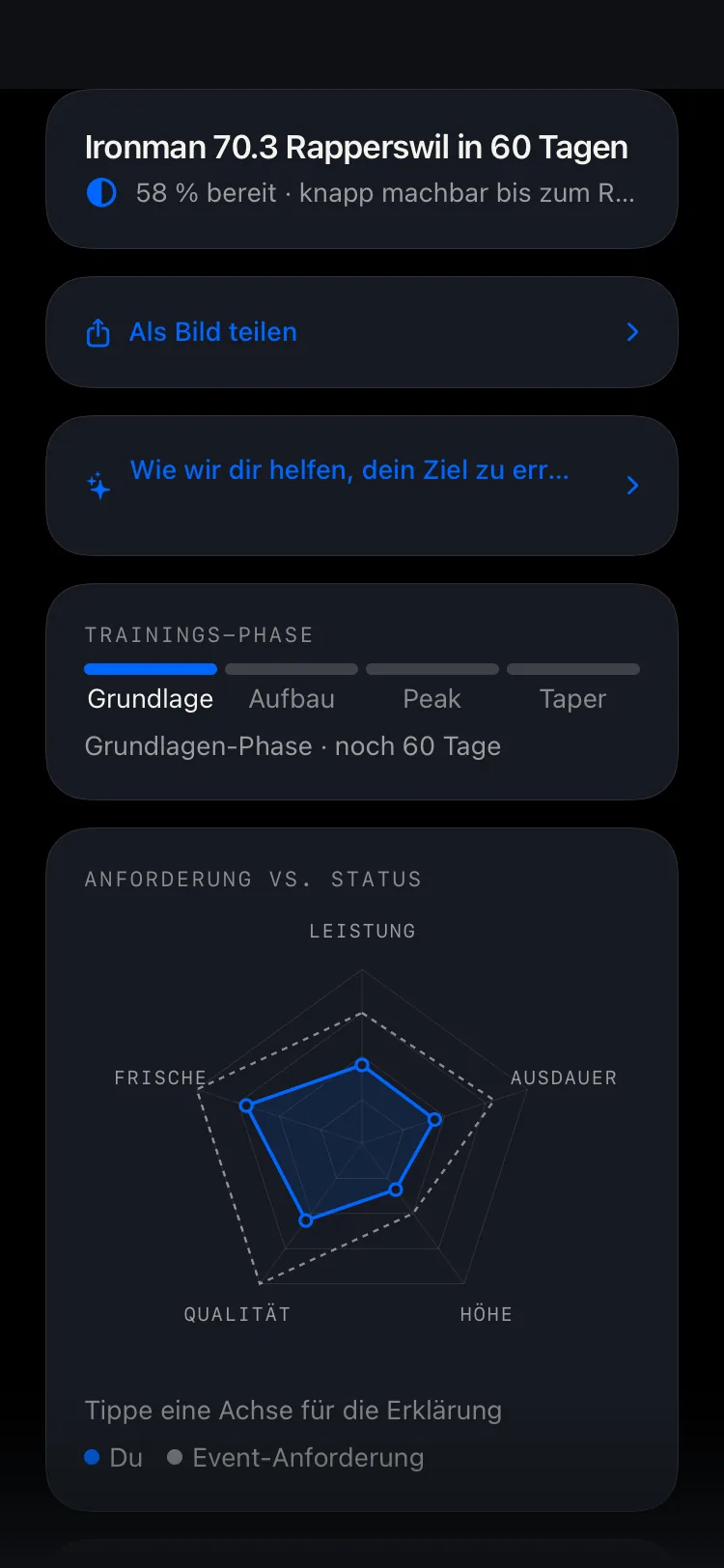
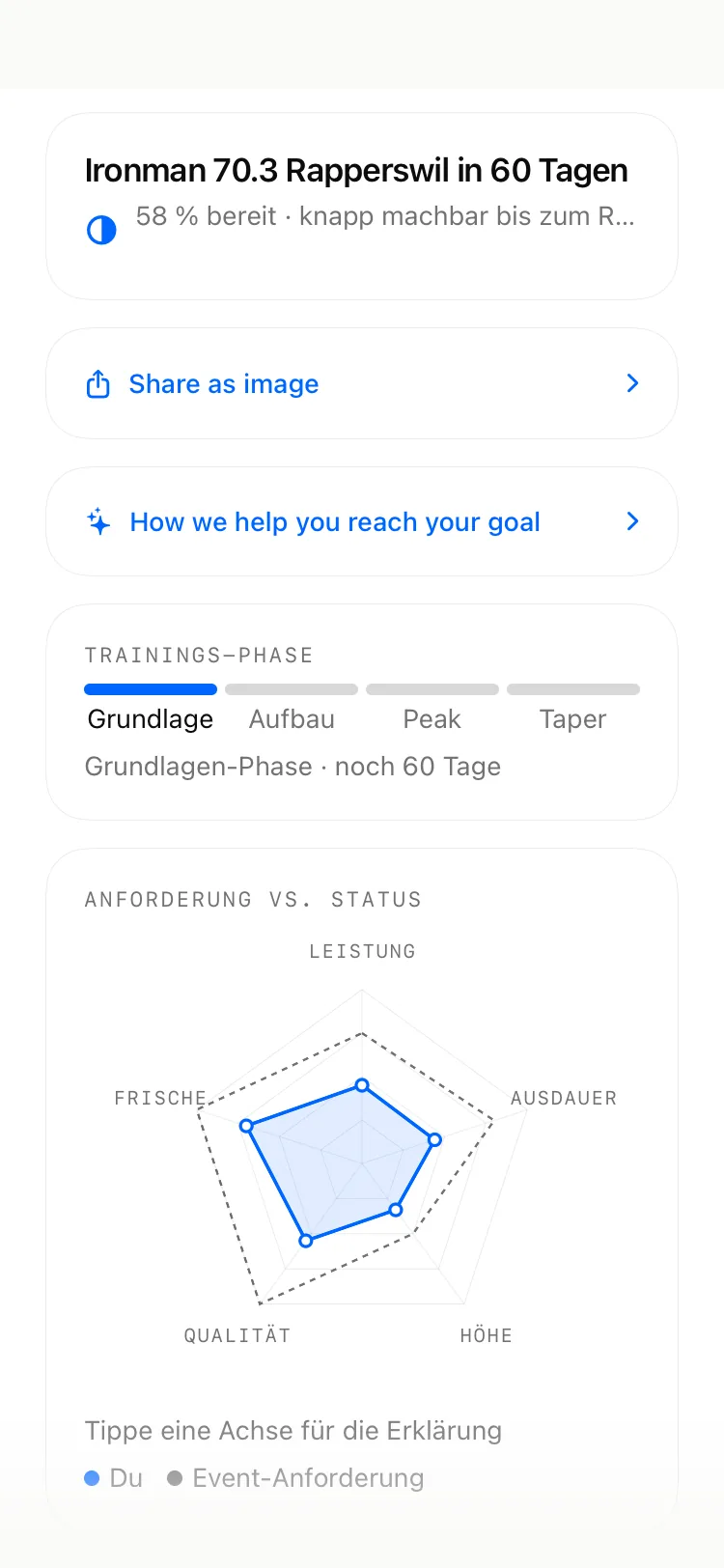
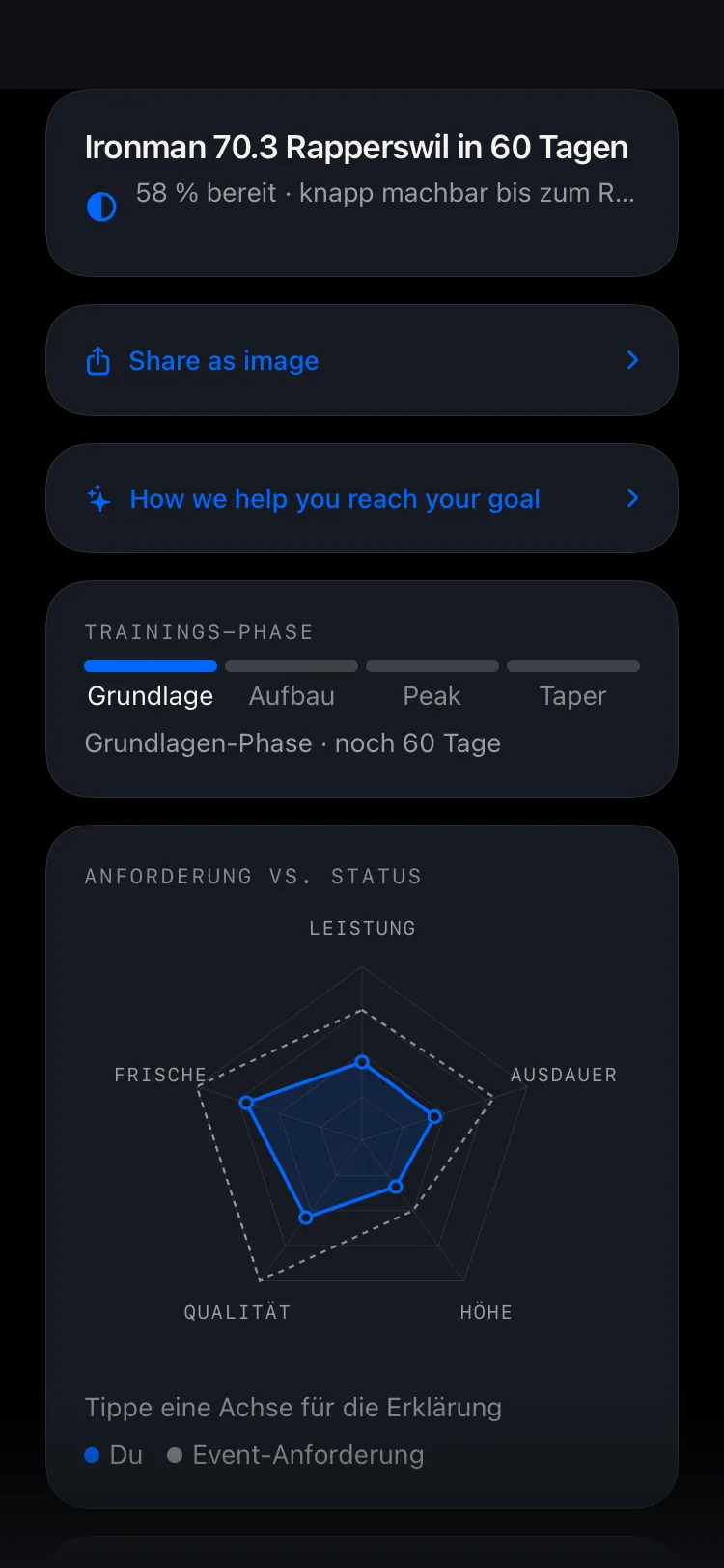
Enter your race and the recommendation changes character: training phase from base through build and peak to taper, readiness in percent, and a radar that puts your standing against what the event demands — broken down per discipline for a triathlon.

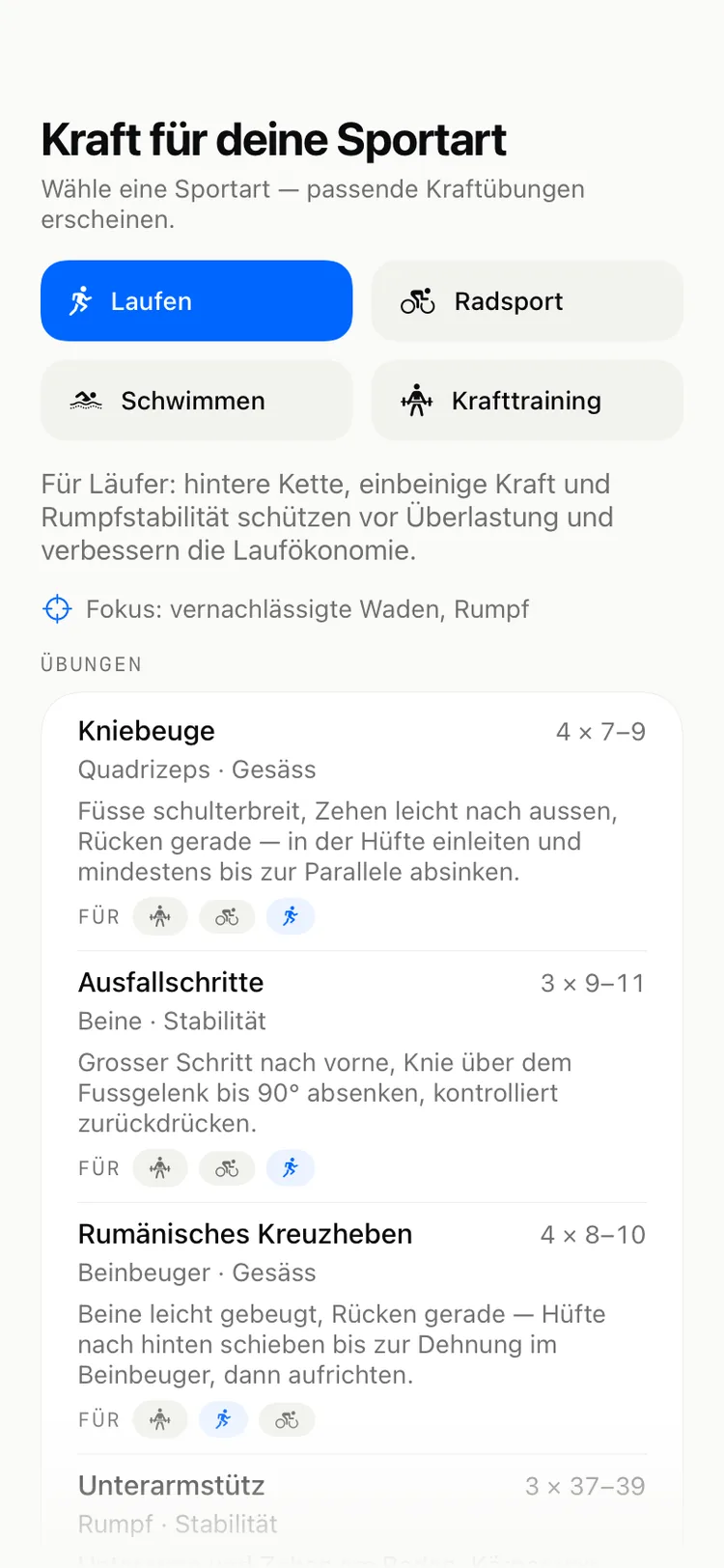
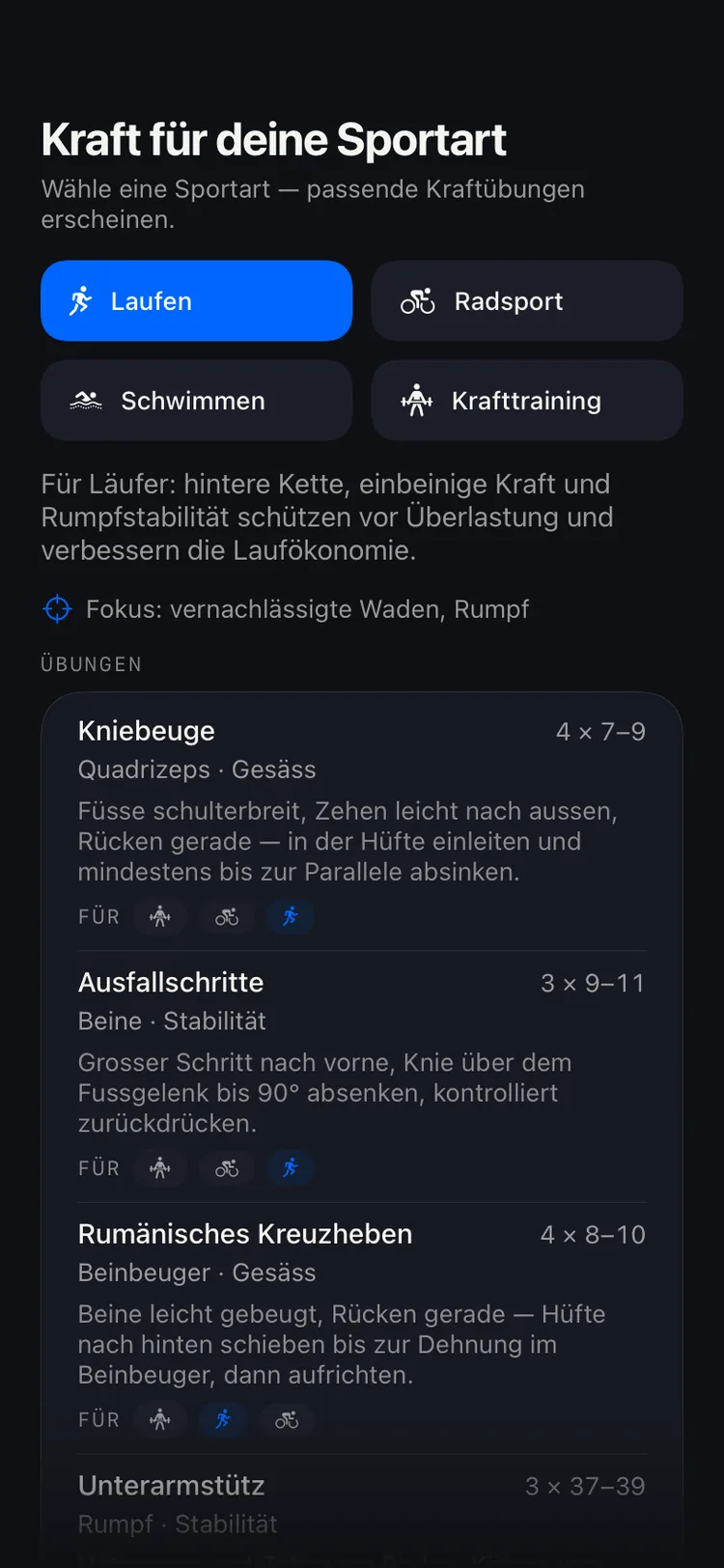
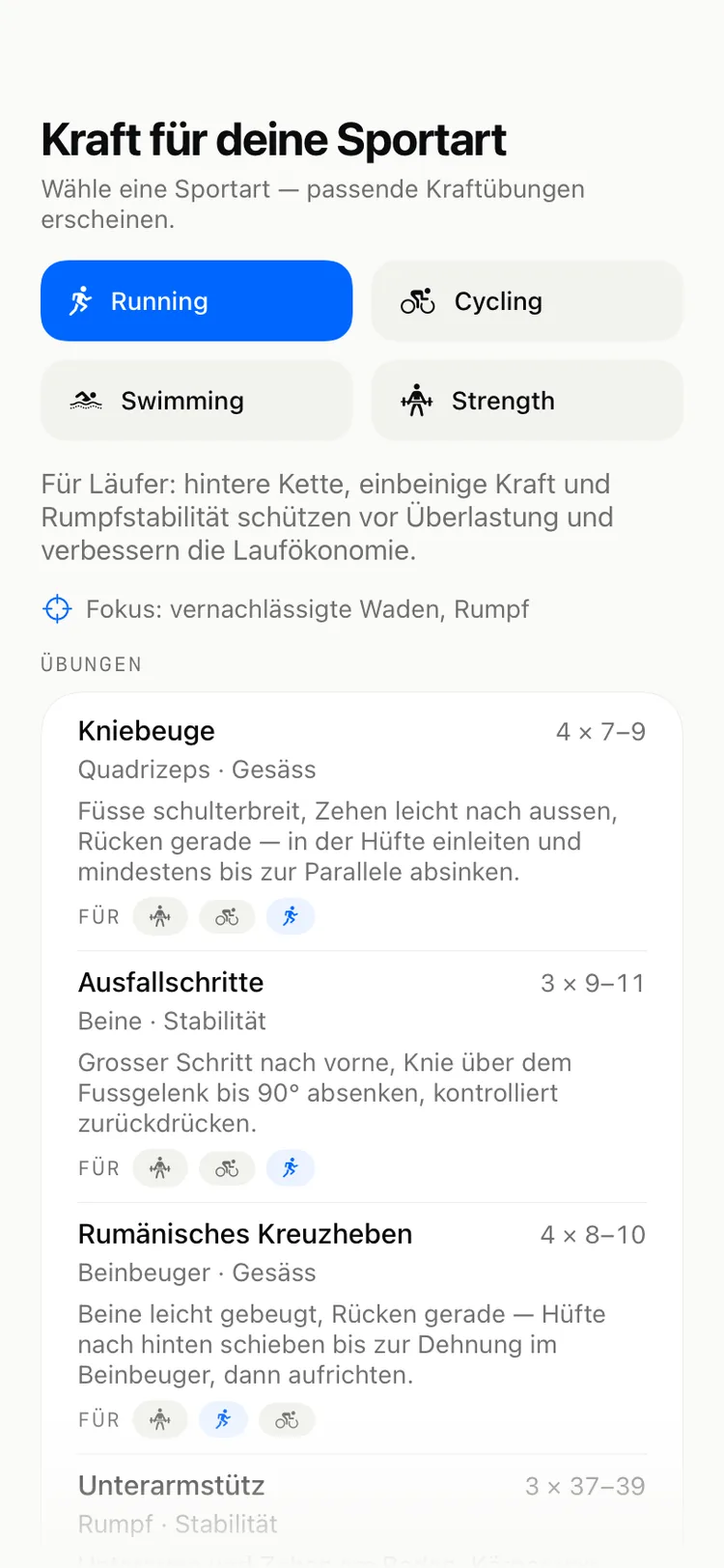
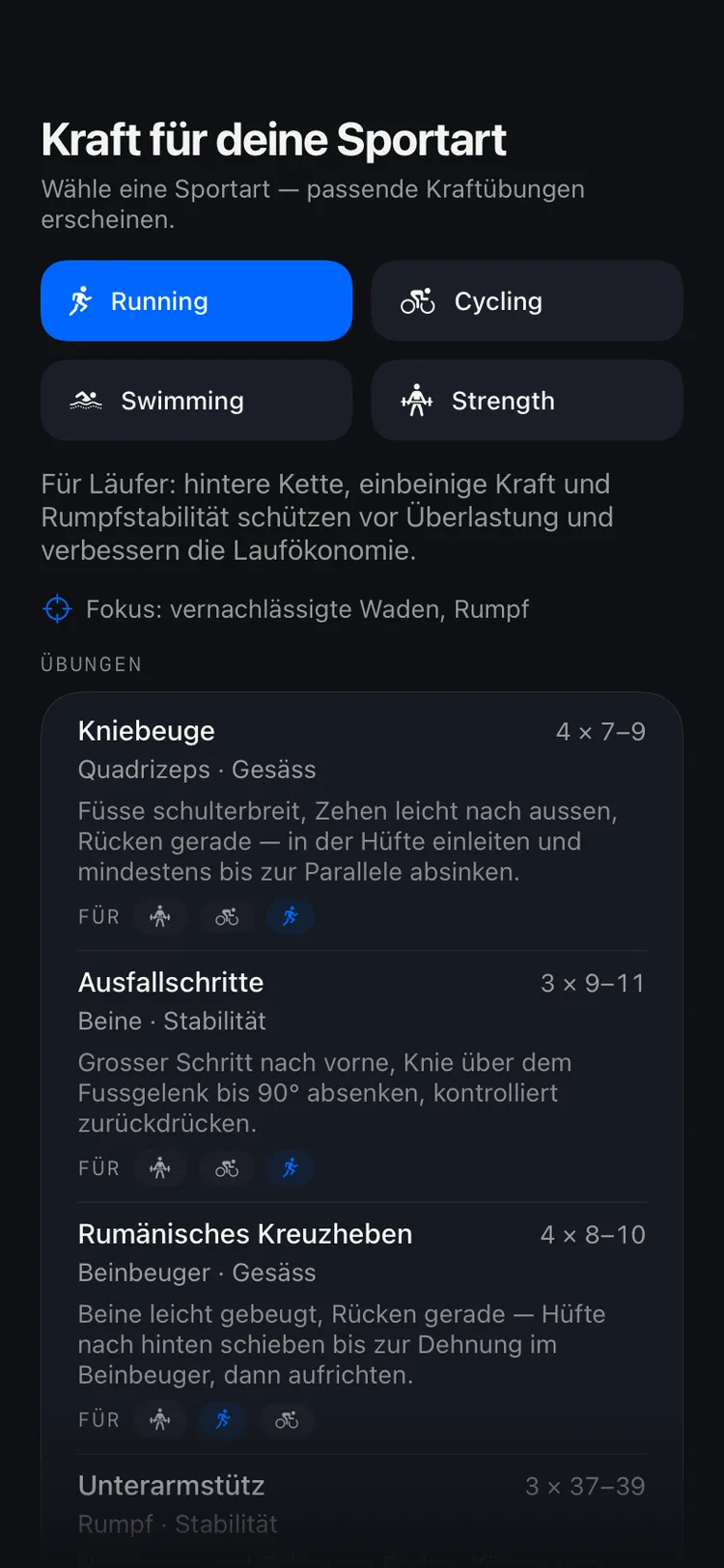
DecisionEngine strength session: automatically chosen exercises with sets and reps DecisionEngine strength session: automatically chosen exercises with sets and reps DecisionEngine strength session: automatically chosen exercises with sets and reps DecisionEngine strength session: automatically chosen exercises with sets and reps

Adaptive strength

Strength that adapts itself.

The app picks the exercises from three things: your sport, your training phase, and the muscles you've recently neglected — with concrete sets and reps, scaled to your level. What you tick off flows back into the next recommendation. Not a fixed programme but a loop fed by real data instead of hope.

DecisionEngine anomaly alert: HRV below baseline, asking for the likely cause DecisionEngine anomaly alert: HRV below baseline, asking for the likely cause DecisionEngine anomaly alert: HRV below baseline, asking for the likely cause DecisionEngine anomaly alert: HRV below baseline, asking for the likely cause

Anomaly detection

It notices when something's off.

HRV clearly below baseline, resting heart rate up: the app speaks up before you feel it yourself — and asks what caused it: alcohol, illness, stress, hard training. Your answer corrects the decision immediately.

DecisionEngine post-workout summary: recovery recommendation with heart-rate and power analysis DecisionEngine post-workout summary: recovery recommendation with heart-rate and power analysis DecisionEngine post-workout summary: recovery recommendation with heart-rate and power analysis DecisionEngine post-workout summary: recovery recommendation with heart-rate and power analysis

After the session

Not the numbers. What they mean.

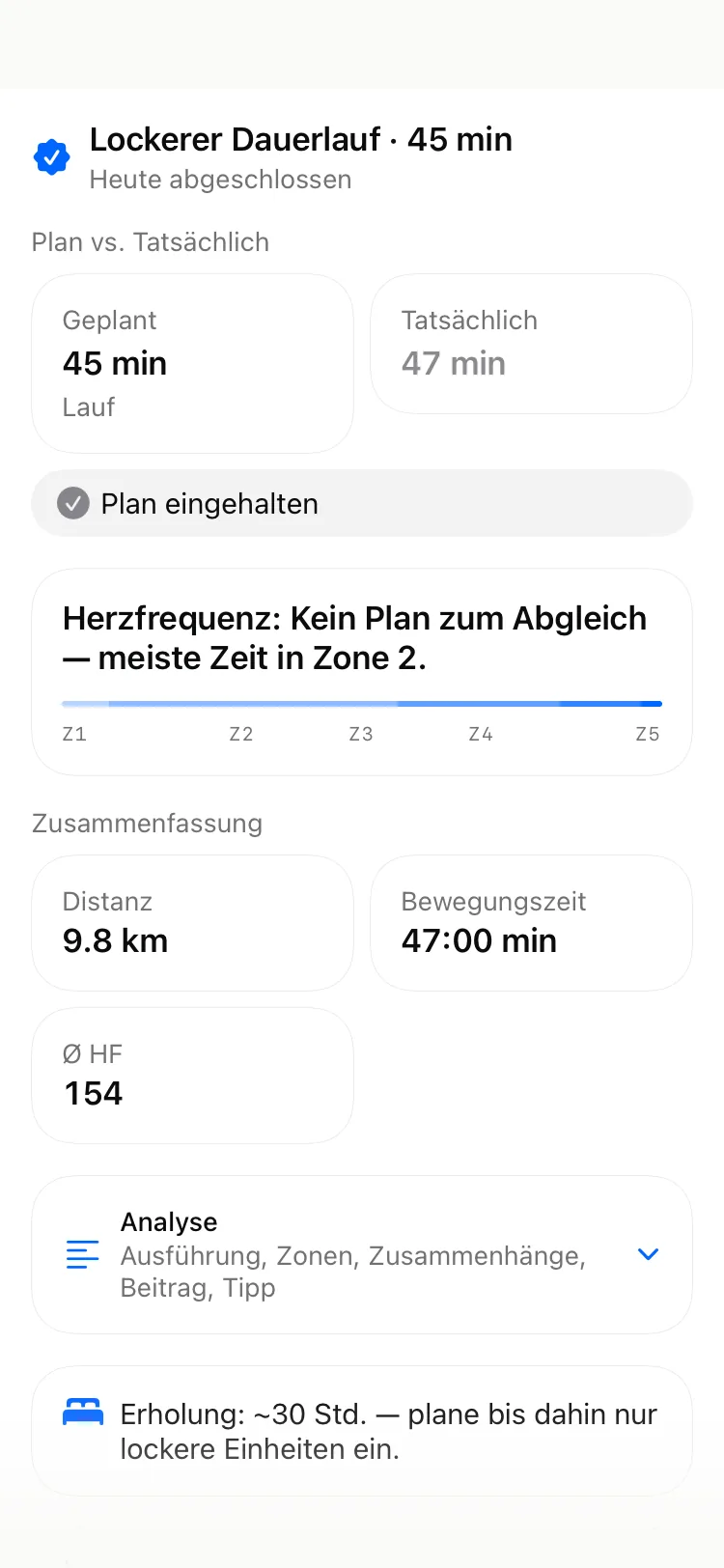
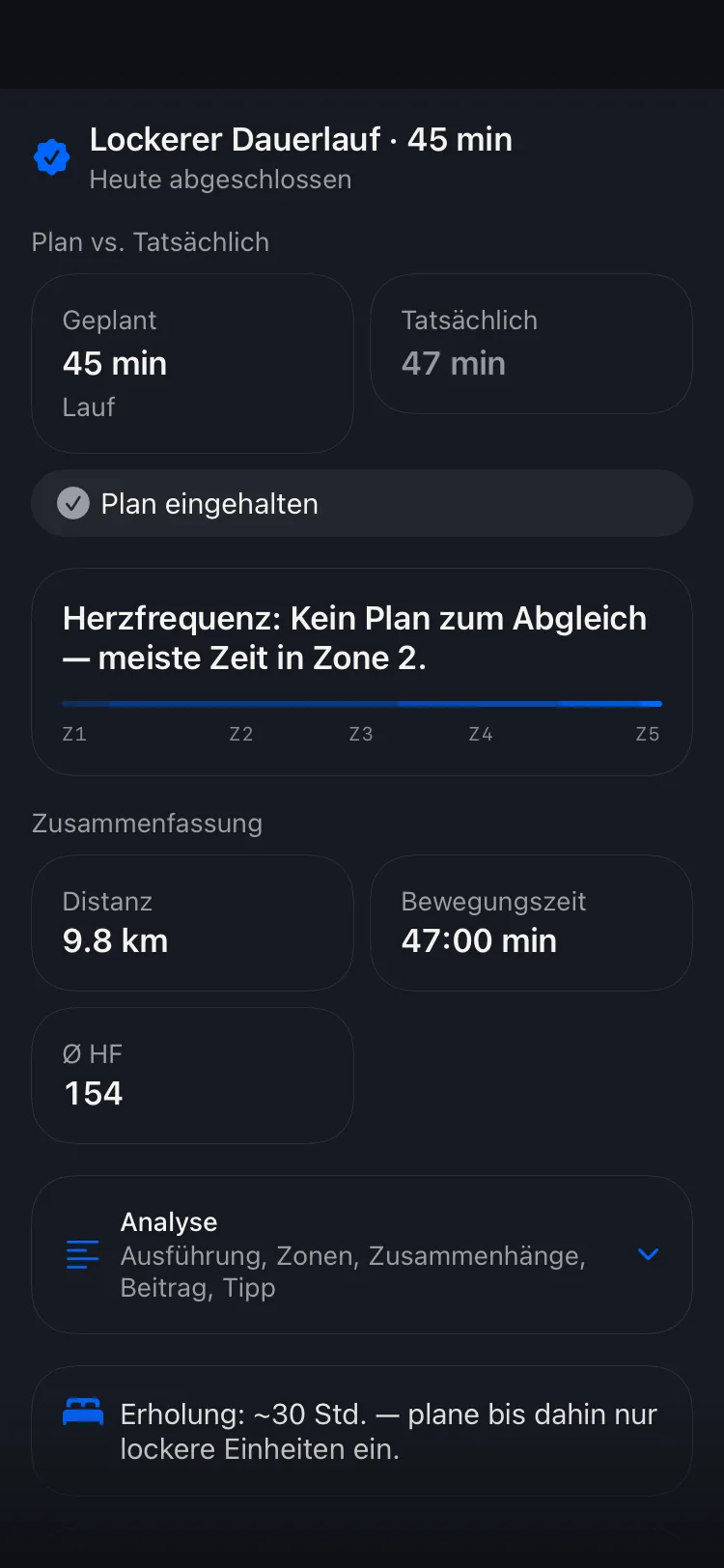
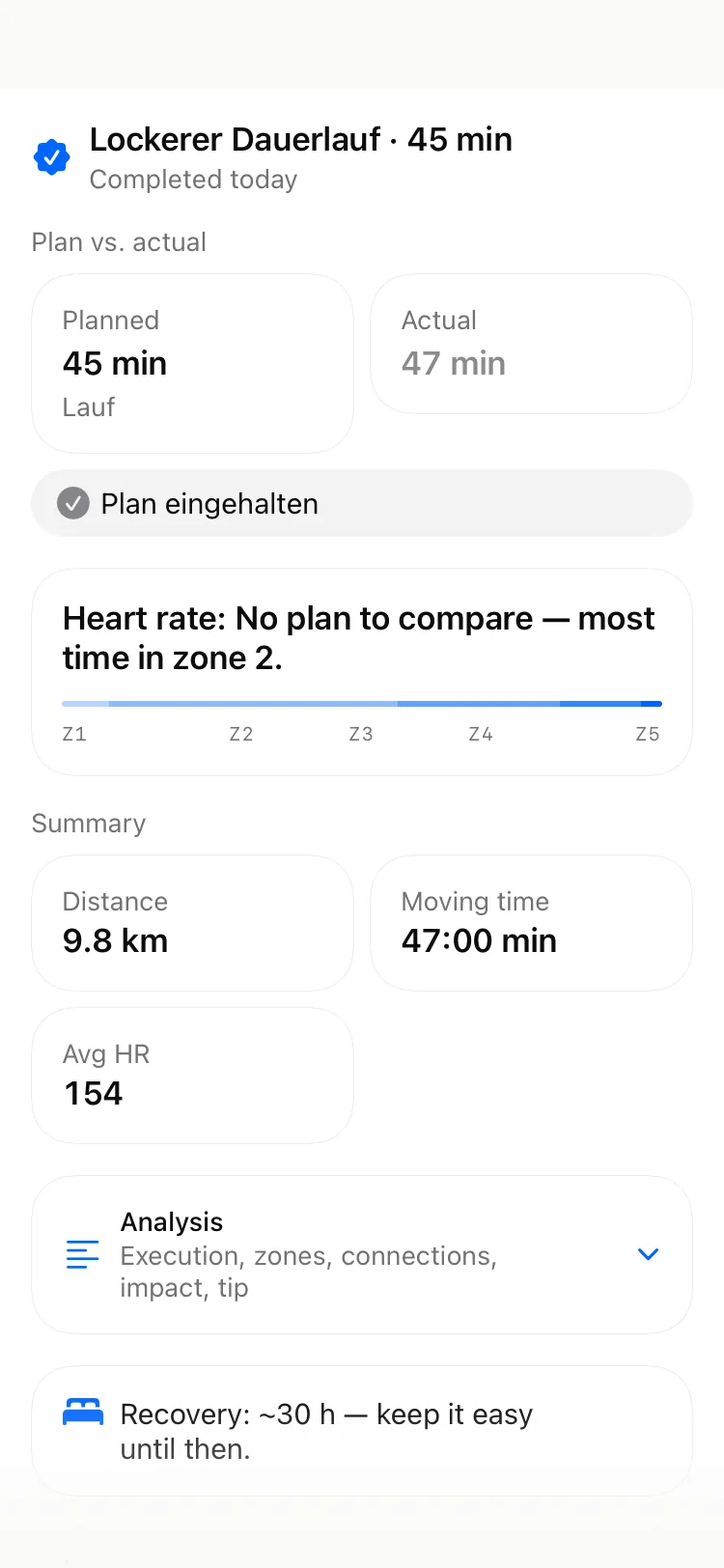
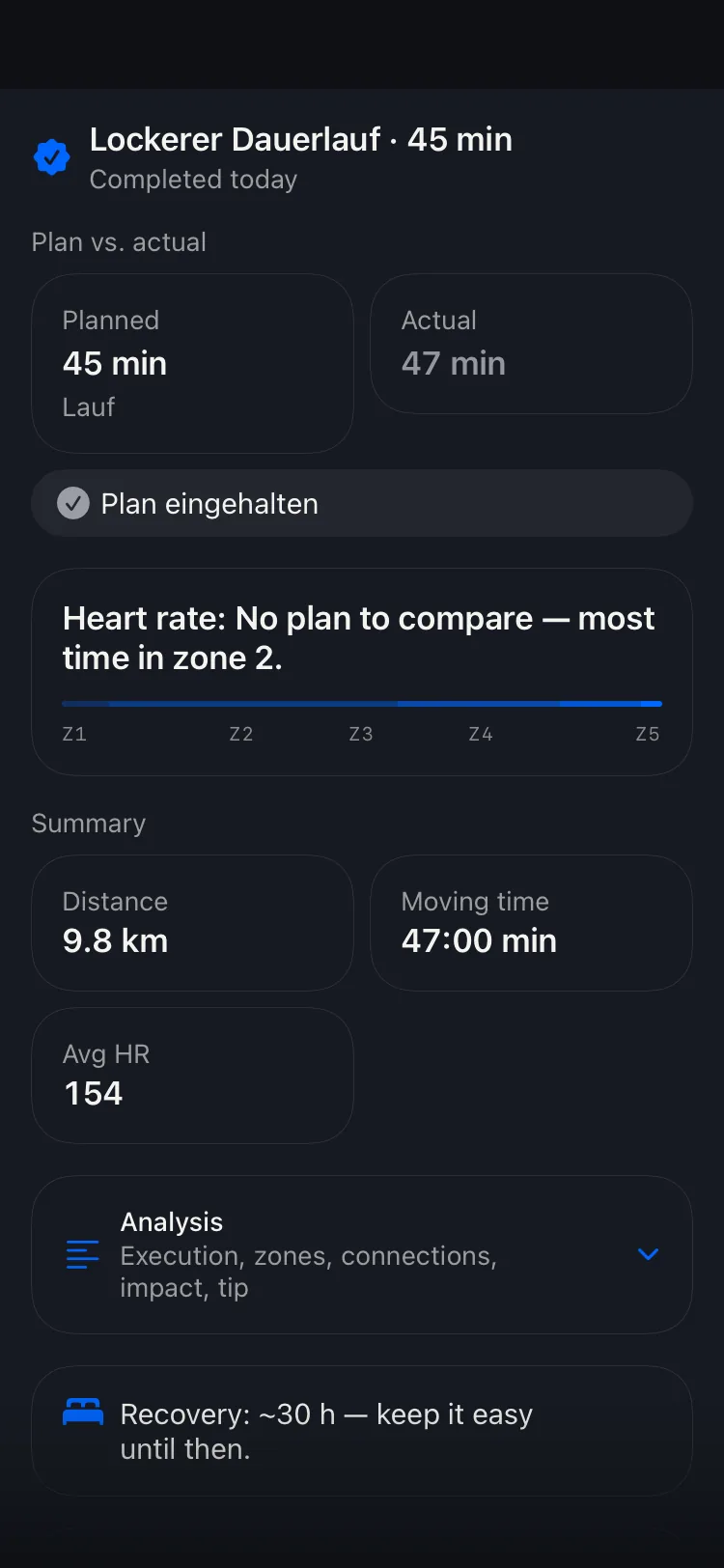
“Recovery: ~30 h — keep it easy until then.” That is the output. Behind it sit heart rate, power, speed and cadence across the whole session, the zone distribution, the comparison with your last five runs and the source of every number — there when you want it. The work is not showing you those curves; it is deriving the next step from how they relate.

How it runs

Set up once. Then open it when you want to go.

01

Connect

Grant HealthKit, optionally add Strava, Garmin, Polar, Wahoo, WHOOP. Duplicate sessions get merged for you.

02

Open it when you want to train

Not the night before, not as a weekly plan. It's for the moment you open it — with last night's sleep and yesterday evening's session already in it.

03

20 seconds, then go

Energy, legs, appetite — three sliders if you like. Then sport, duration, intensity, zones plus the reasoning. One tap to your Watch.

Also: Apple Watch · widget & lock screen · Siri · ask the coach · race brief · routes in history · export to Garmin & co · audio coaching

Michael, Gründer von DecisionEngine

Who builds this

Michael. Personal training taught me how hard true personalization actually is — it would take a coach by my side before and after every session, because no two days are the same. That's exactly what DecisionEngine replaces: a decision, unique to the moment right before training. Not a plan off the shelf.

Beta

We invite in small waves.

We open new seats roughly every two weeks, so every piece of feedback actually lands. Free for as long as the beta runs — and testers get a thank-you bonus at launch.

See what has been built so far →

Quick questions

Is this a training plan?

No. There's no weekly plan to work through. There's one decision for the moment you ask — plus the reasoning. A race goal gives it direction without forcing a calendar on you.

Is this another AI coach app?

No — and that's exactly the difference. Your data is not sent to an AI that writes a workout back to you. Nothing leaves your iPhone: everything is computed on the device, using the ML capabilities already built into it. The decision comes from sports-science models — load ratio, recovery, periodisation. What learns over time learns from your data, on your device, for you alone — no third-party model is trained on it. Where text explains something it only translates numbers that were already computed; invented values are discarded and you get the plain version instead.

When does the beta open?

TestFlight is already running. We invite roughly every two weeks so feedback actually gets processed instead of piling up.

What do I need to run it?

An iPhone running iOS 26 or newer. The app computes locally with the ML capabilities built into it — hence the requirement.

Do I need an Apple Watch?

No. A Watch or a connected provider gives better data, but HealthKit from the iPhone is enough to start.

What happens to my data?

It stays on the device. There is no account and no server we could store it on. Provider connections are optional and individually revocable.

What will it cost later?

After launch, a single Pro subscription with a trial. During the beta you pay nothing — and testers get a thank-you bonus at launch.